How Long Does It Take For Deck Stain To Dry

You’ve power-washed, scrubbed, and sacrificed a Saturday to the deck gods. Now the stain is down, and you’re standing there like a nervous parent at a first piano recital. The...
You’ve power-washed, scrubbed, and sacrificed a Saturday to the deck gods. Now the stain is down, and you’re standing there like a nervous parent at a first piano recital. The big question: how long does deck stain take to dry?
Short answer: somewhere between “long enough to grab a sandwich” and “did I accidentally stain a glacier?” The real answer depends on the stain, the weather, the wood, and how much the universe wants to test your patience.
First, “Dry” Is a Loaded Word
When people ask how long deck stain takes to dry, they usually mean three different things. Dry to touch, dry enough to walk on, and fully cured are not the same beast.
Must Read
Dry to touch means you can poke it gently and not leave a fingerprint. Dry enough to walk on means your dog can sprint across it without creating a paw-print crime scene. Fully cured means the stain has hardened into its final, weather-fighting armor.
Water-Based Stain: The Speedy Roommate
Water-based deck stains are the overachievers of the stain world. They often feel dry to the touch in 1 to 2 hours, depending on temperature and airflow.
You can usually recoat in 2 to 4 hours. But don’t host a deck party yet, because light foot traffic often waits 24 to 48 hours.
Full cure can take several days, sometimes longer if humidity is high. Think of it as a cake that looks done but is still secretly molten in the middle.
Oil-Based Stain: The Slow-Cooker of Coatings
Oil-based stains take their sweet time. They might be dry to touch in 4 to 8 hours, and recoating often means waiting 12 to 24 hours.
Walking on an oil-stained deck can require 24 to 72 hours, and furniture should stay off for even longer. Full cure can stretch into days or weeks, especially in cool, damp weather.
Here’s a weird fact: oil-based stains don’t just dry by evaporation. They cure by oxidation, which means they absorb oxygen and harden over time. Basically, your deck is breathing.
The Weather Is a Drama Queen
Temperature matters more than most people expect. Ideal conditions are usually 50°F to 80°F, with low humidity and a gentle breeze.
Below 50°F, stain can turn into molasses. Above 90°F, it may skin over too fast while the underneath stays sticky.
Humidity is the silent villain. If the air is swampy, water-based stain can’t evaporate, and oil-based stain can take forever to cure.
Direct sun can also cause trouble. It bakes the surface while hiding moisture below, which is a recipe for peeling and regret.
 How Long Does Behr Deck Stain Take To Dry?
Airflow: Your Free Drying Assistant
A breeze is like a tiny fan club for your stain. It pulls moisture away and helps the surface set evenly.
But don’t aim a leaf blower at fresh stain unless you want a speckled masterpiece. Gentle air is good; a wind tunnel is not.
The Wood Itself Has Opinions
Wood is not a uniform surface; it’s a chaotic sponge with mood swings. Porous woods like pine and cedar can soak up stain fast, while dense woods like mahogany may resist.
New wood, old wood, weathered wood, and wood that has been pressure-washed all behave differently. Even the same deck can have thirsty boards and stubborn boards sitting side by side.
That’s why one section may feel dry while another still feels tacky. Your deck is not a monolith; it’s a drama club.
Weird Things That Affect Drying Time
Stain color can matter a little. Darker stains absorb more heat, which can speed surface drying but sometimes trap moisture underneath.
Thick coats feel productive, but they dry slower and may stay gummy. Two thin coats usually beat one heroic slop.
And yes, old stain underneath can slow things down. If it’s failing or peeling, new stain may sit on top like a bad toupee.
A Rough Timeline You Can Actually Use
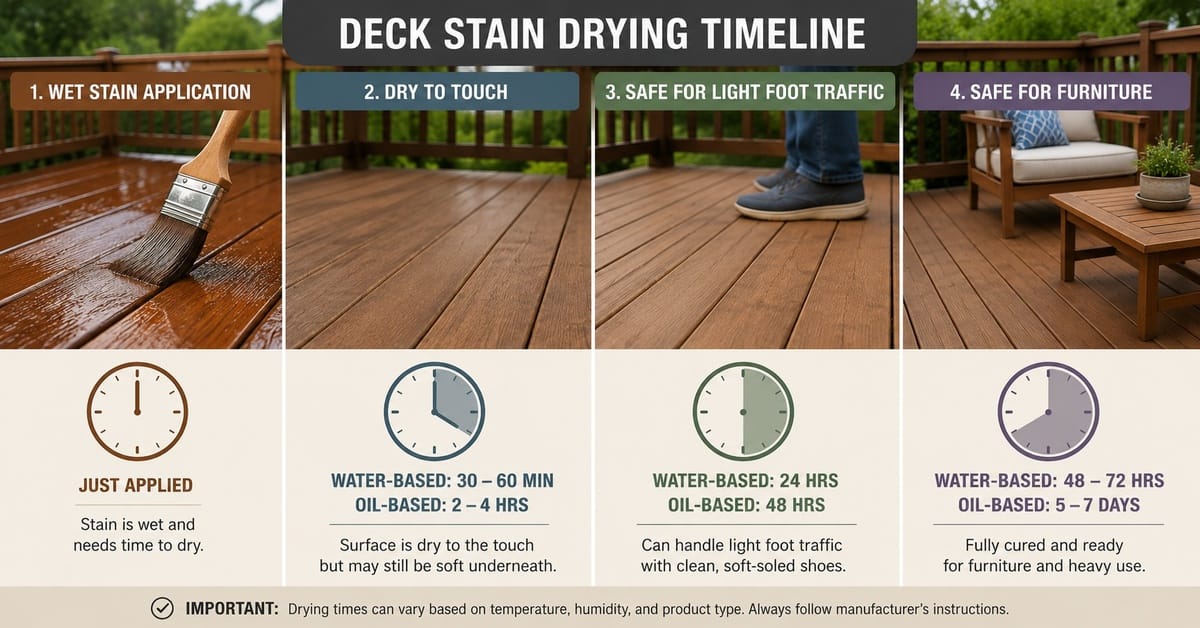
For a typical water-based stain in good weather: touch dry in 1 to 2 hours, recoat in 2 to 4 hours, light foot traffic in 24 hours, furniture in 48 hours.
For a typical oil-based stain in good weather: touch dry in 4 to 8 hours, recoat in 12 to 24 hours, light foot traffic in 24 to 72 hours, furniture in 3 to 7 days.
Full cure for either? Give it a week, maybe more. If you want to be safe, wait longer than you think you need.
 How Long Does Deck Stain Take to Dry? A Deck Staining Timeline for Best
How to Test Without Leaving a Fingerprint
Don’t test with your hand if you want to keep your dignity. Touch a hidden spot, like a corner or the back of a step.
Press a clean rag or paper towel gently. If stain transfers, it’s not ready. If it feels tacky, it’s definitely not ready.
You can also check the manufacturer’s label. It knows more about your specific stain than your neighbor Gary, who once stained a fence in the rain.
How to Speed Things Up Without Ruining Everything
Pick a dry, mild day with low humidity. Start early enough that the stain has hours of decent weather before evening dew shows up.
Improve airflow with fans or open space, but keep them gentle. Avoid direct blazing sun if the label warns against it.
Don’t crank the heat. Heat guns and blowtorches are for action movies, not deck stain.
What Happens If You Rush It
Walk too soon, and you’ll leave footprints. Set furniture too soon, and you’ll get mysterious leg-shaped marks that look like abstract art.
Rain within the first 24 to 48 hours can wash stain right off, especially water-based formulas. That’s not a fun surprise for your lawn.
Rushing also means uneven color, peeling, and a deck that looks tired before its time. Patience is boring, but it’s cheaper than redoing the whole thing.
The Bottom Line
Most deck stains are touch-dry in a few hours, walk-ready in a day or two, and fully cured in a week or so. But weather, wood, and product type can stretch that timeline like warm taffy.
So plan for 24 to 72 hours before normal use, and give it a full week before you drag out the grill. Your deck will thank you by not sticking to your socks.
And if anyone asks how long deck stain takes to dry, tell them: long enough to teach you humility, but not long enough to ruin your weekend. Probably.
