You Can Go Back But Nobody Will Be There

Last spring, I drove four hours to eat a sandwich. Not just any sandwich — the one from a deli near my old apartment, the place I hit every Saturday after a run, sweaty and i...

Last spring, I drove four hours to eat a sandwich.
Not just any sandwich — the one from a deli near my old apartment, the place I hit every Saturday after a run, sweaty and insufferably pleased with myself. Warm bread, slightly too much mustard, the owner yelling at a radio nobody else could hear.
The deli was still there. The sandwich was fine. Everything else had quietly moved on without me.
Must Read
The owner had sold up two years earlier. The radio was gone, replaced by a speaker playing something generic, and the guy behind the counter looked at me like I'd asked for the keys to his car when I mentioned the hot peppers.
I ate standing up. Then I sat in my car for ten minutes, feeling like a man who had driven four hours to learn something he already knew.
You've done a version of this. A street, a school, a house, a bar. Same address, different world.
Places Are Containers, Not Time Machines
A place is just a container. It holds walls, chairs, a particular smell, a tile pattern you'd recognise anywhere on earth.
What it never holds is the people who made it mean something. And that, of course, is the part you actually miss.
A building can stay identical for forty years and still fail you. Because the thing you're chasing was never the building. It was the crowd inside it, including a version of you that no longer exists.
This is where nostalgia gets sneaky. It edits ruthlessly, and it always cuts itself out of the footage.
You remember the long summer evenings and the laughing on the porch. You forget the fight, the debt, the fact that you cried in a parking lot that one Tuesday.
Nostalgia is a brilliant filmmaker and a terrible documentarian.
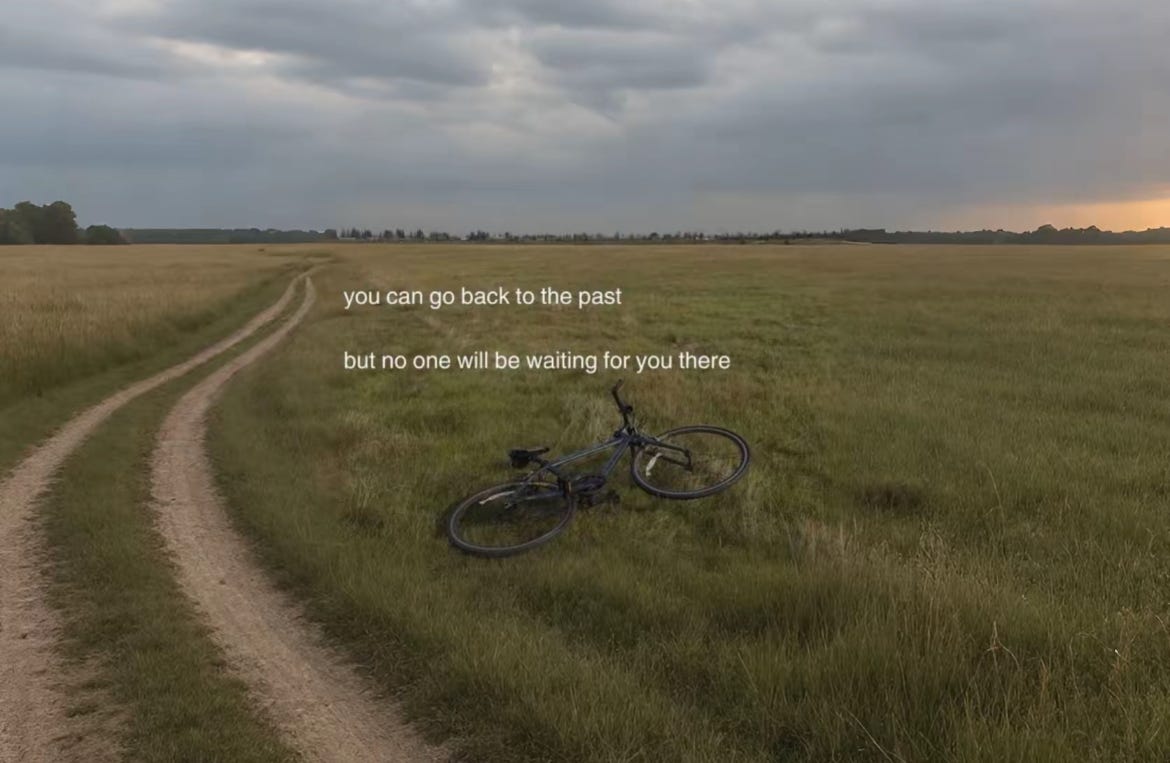 You can go back to the past, but no one will be waiting for you there
Reunions Are a Controlled Experiment
Reunions are where this idea gets tested in public. Everyone shows up expecting a place, and everyone leaves having found a room full of strangers who happen to share a memory.
That isn't a failure. It's just what time does to a group of people, quietly and without asking permission.
The friend who once made you laugh until you couldn't breathe is still in your head somewhere. The person in front of you has a mortgage, a divorce, a bad knee and a completely different haircut.
You can love them both. You just can't merge them.
And Then There Are the Ones Who Stayed
Some people never left your hometown, and that's a different kind of ache. They know the new traffic lights and the restaurant that opened inside the old bank.
You arrive as a visitor with a memory. They arrive as a resident with a routine. It isn't a competition, but some evenings it can feel like one.
The Version of You Who Lived There
There's another awkward truth hiding in all of this. When you go back, you're not the same person who left, either.
And honestly? Sometimes that earlier version of you isn't someone you'd want to spend an afternoon with now.
I was slightly unbearable at twenty-three. If I met that guy at a party, I'd find an excuse to leave early and then text about it.
The Cheaper Way to Time Travel
If you want the feeling without the disappointment, there's a shortcut. Pull up the address on a map and drop the little yellow figure onto the street.
 You can go back to the past but no one will be waiting for you there
It's strange and a bit addictive. You'll see the tree you climbed, the fence nobody ever repaired, the corner where you waited for a bus in the rain.
It's a clean hit of nostalgia with basically no risk attached. Nobody is there, so nobody can let you down. That's the trade-off, and sometimes it's the right one.
So What Is Going Back Actually For?
None of this means you shouldn't go back. It just means you should stop expecting the trip to be a resurrection.
Go see the house. Take the photo. Walk the old route and notice what's changed and what stubbornly refuses to.
Just don't stand outside waiting for the lights to flick on and the door to swing open with your name in it. That scene exists mainly in films, and even there it's usually a metaphor.
What you can do is call the people who are still reachable. Text the friend from the old neighbourhood. Ask the question you've been meaning to ask for nine years.
That's the real trip. Less scenic, doesn't photograph well, and yet it's the only version that actually goes anywhere.
Because here's the punchline: the place was never the point. It was the backdrop, and you were always the one carrying it around.
You can go back. The building will be there, patient and completely indifferent.
But if you want the warmth, you have to find the people. Or accept that they've moved on, and go find some new ones.
