Rotation Of 90 Degrees About The Origin

Picture a piece of graph paper. Right in the middle is a dot called the origin — that's just the point (0, 0). Now draw a little triangle somewhere on the paper. If you spin t...
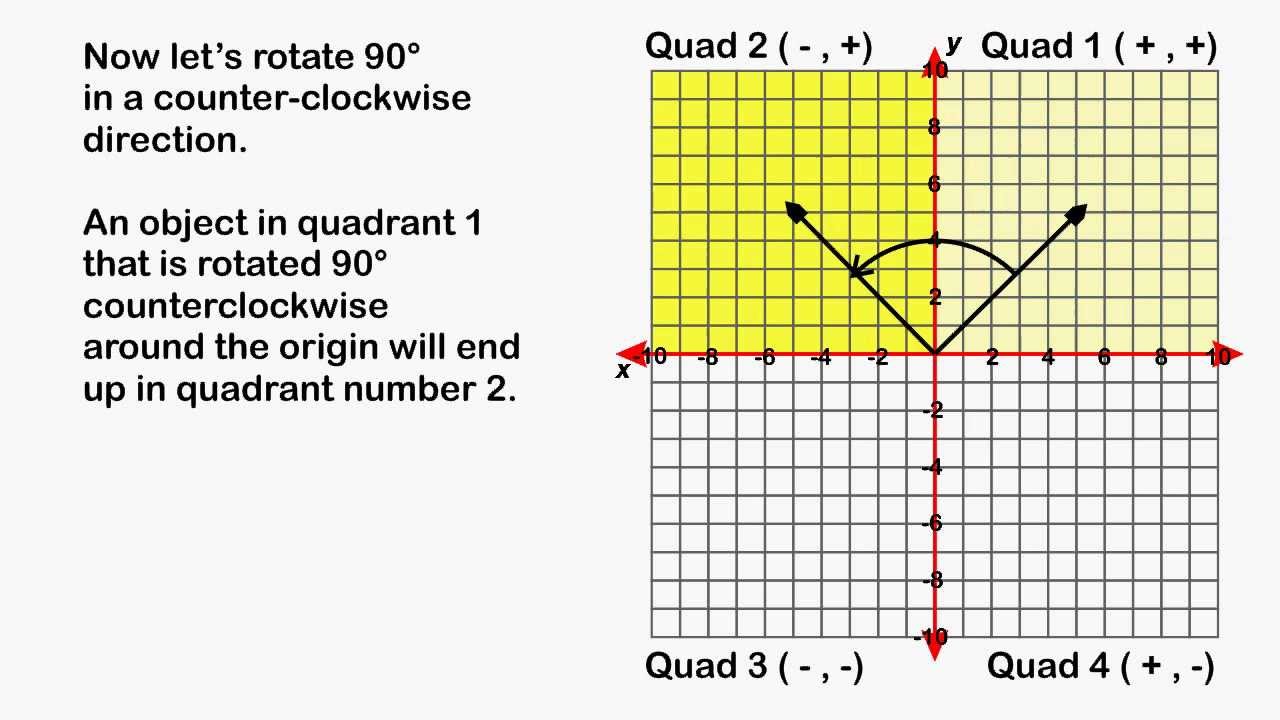
Picture a piece of graph paper. Right in the middle is a dot called the origin — that's just the point (0, 0). Now draw a little triangle somewhere on the paper.
If you spin that whole paper 90 degrees around the origin, the triangle moves. But the origin stays put. It's like a lazy Susan pinned at the center.
That's all a 90-degree rotation about the origin is: a quarter turn around a fixed center point. Simple, right? But it shows up everywhere.
Must Read
Why Should You Care?
You already rotate things without thinking. Turning your phone from portrait to landscape? That's a 90-degree rotation. Rotating a photo in an editing app? Same idea.
Video game characters spin, maps flip, furniture gets rearranged. Even a dancer doing a sharp quarter turn is using this math. It's the quiet choreography behind a lot of daily life.
And once you know the rule, you can predict exactly where every point lands. No guessing. No spinning in circles — unless you want to.
It's a small skill that makes geometry feel less like homework and more like a superpower.
The Magic Rule (No Wand Required)
Counterclockwise in One Line
Here's the trick for a counterclockwise 90-degree turn. Take any point (x, y). Swap the numbers, then make the new first number negative.
So (x, y) becomes (-y, x). Let's try it. Point (2, 1) becomes (-1, 2).
Point (5, 0) becomes (0, 5). Point (0, 3) becomes (-3, 0). See the pattern?
The x and y trade places, and one sign flips. That's the whole secret. For a clockwise turn, use (y, -x) instead.
Why does this work? Because a 90-degree turn is a quarter circle. Every point swings around the origin like a kid on a merry-go-round.
 Counterclockwise Rotation 90 Degrees Origin
The distance from the center stays the same. That's why the rule only swaps and flips signs. It's preserving the radius.
A Tiny Story: The Cup on the Table
Imagine a square table with its center at (0, 0). You place a cup at (3, 1). Now rotate the table 90 degrees counterclockwise.
The cup ends up at (-1, 3). If you had a napkin at (4, -2), it lands at (2, 4). The table's center never moves.
That's the key: the origin is the anchor. Everything else orbits around it. Miss that, and your rotation becomes a weird slide.
Where You'll See It in Real Life
Computer graphics use this constantly. When you rotate a 3D model or spin a character in a game, the math is built on 90-degree turns. Architects rotate floor plans, and robot arms rotate parts on assembly lines.
Even wrapping a present can involve a quarter turn. You rotate the box so the paper lines up. The center of the box stays roughly in place while the corners swing around.
And if you've ever tried to park a car, you've felt rotation. The steering wheel turns, and the car pivots around a point. Not exactly the origin, but the same idea.
Try It Yourself (It's Weirdly Fun)
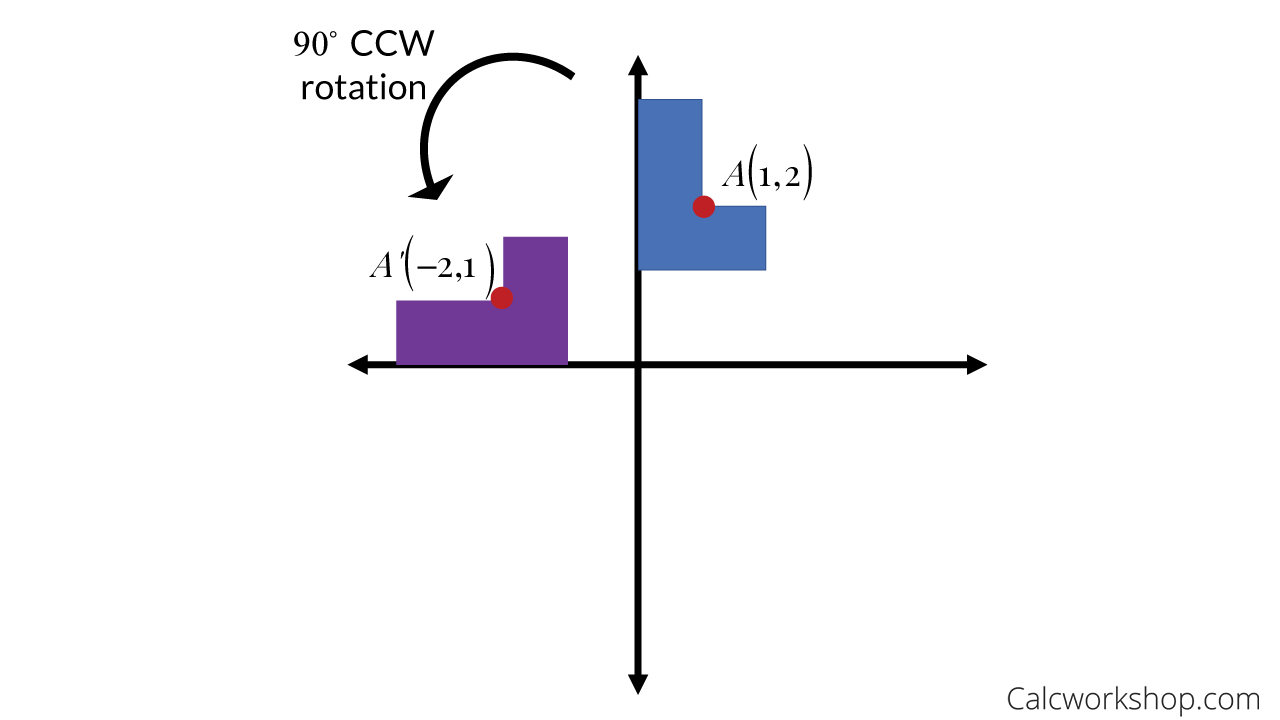
Grab a sticky note and draw a dot at (1, 2). Rotate the note 90 degrees counterclockwise around the corner you call (0, 0). The dot should land at (-2, 1).
Now rotate it again. (-2, 1) becomes (-1, -2). Again: (-1, -2) becomes (2, -1).
 Counterclockwise Rotation 90 Degrees Origin
One more time: (2, -1) becomes (1, 2). You're back where you started. Four quarter turns equal a full 360-degree spin.
That's a satisfying little loop, like a dance move that ends in the same pose.
The One Mistake Everyone Makes
People often forget that the origin is fixed. They rotate the shape but also move the center. That's not a rotation; that's a rotation plus a slide.
Another mix-up is clockwise versus counterclockwise. Just remember: counterclockwise goes left at the top. Clockwise goes right.
Or think of a clock's hands moving forward. If you get confused, test a point on the x-axis. Point (5, 0) rotated counterclockwise 90 degrees should go straight up to (0, 5).
That's easy to picture. And it proves the rule in one quick glance.
So, Why Bother?
Because rotation is one of the simplest ways to think in space. It turns a confusing shape problem into a quick swap and sign flip. And it connects to art, games, engineering, and even parking.
Next time you turn your phone, rotate a photo, or spin a pizza box, smile. You're doing a 90-degree rotation about the origin — or at least a close cousin of it.
Math doesn't have to be scary. Sometimes it's just a quarter turn that makes everything line up.
