Why Are There 5280 Feet In A Mile

Five thousand two hundred eighty. It’s a number that sounds like a locker combination, not a measurement. But that’s exactly how many feet hide inside a mile. If you’ve ever d...
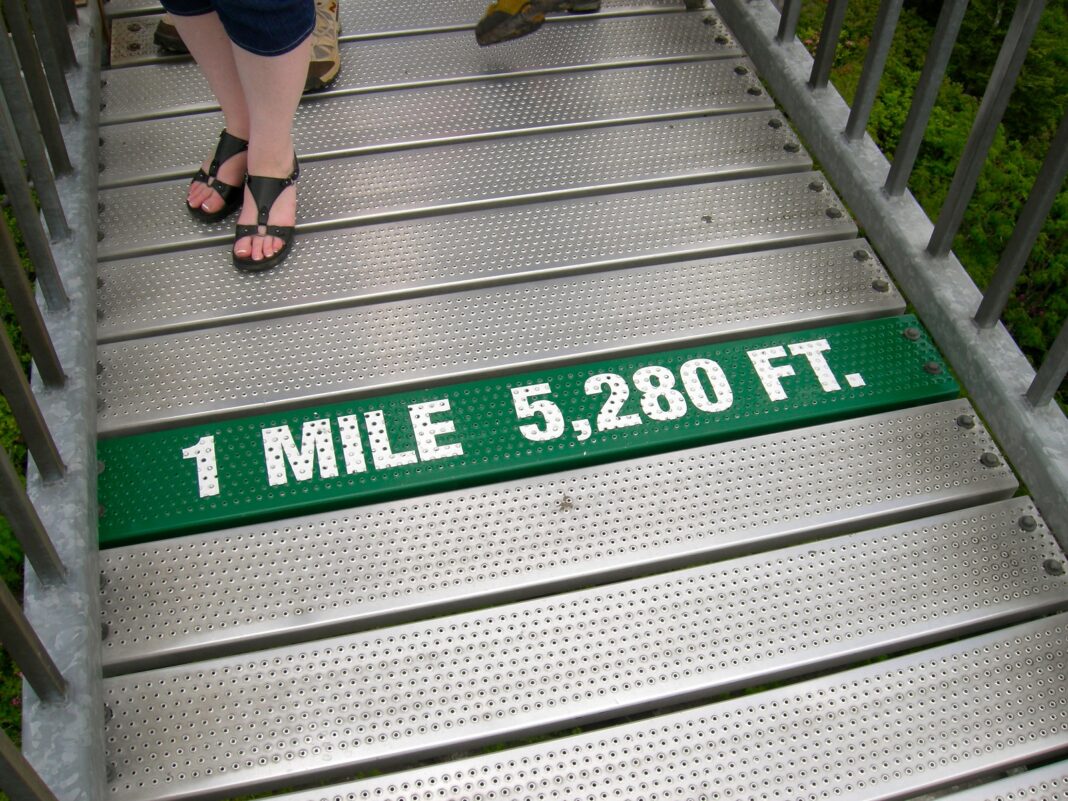
Five thousand two hundred eighty. It’s a number that sounds like a locker combination, not a measurement. But that’s exactly how many feet hide inside a mile.
If you’ve ever driven past a “Next exit: 1 mile” sign, you’ve trusted this number. If you’ve jogged four laps on a track, you’ve thanked it. If you’ve walked to the coffee shop and back, you’ve probably covered one without noticing.
So why not a nice, tidy 5,000 feet? Or 6,000? Because miles weren’t invented by mathematicians with a love of round numbers. They were invented by soldiers, farmers, and lawmakers who each added their own layer.
Must Read
First, the Romans Took a Walk
The word “mile” comes from the Latin mille passus. That means “a thousand paces.” A Roman pace was not one step, but two—left foot, right foot.
So a Roman mile was about 1,000 double-steps. That worked out to roughly 5,000 Roman feet. Not 5,280 English feet, because Roman feet were a bit shorter than the ones we use now.
Roman soldiers could count paces while marching. It was a practical way to measure roads, camps, and empires. But when the Roman Empire faded, Britain didn’t just keep the Roman mile exactly as it was.
Then the Farmers Showed Up
In old English fields, land was measured in furlongs. A furlong was the length of a strip of land a team of oxen could plow before needing a rest.
Picture an ox with a very strong opinion about lunch breaks. The furlong became a standard length of 660 feet. It was also tied to the acre, which was the amount of land one team could plow in a day.
An acre was traditionally one furlong long and four rods wide. A rod, by the way, is 16.5 feet—about the length of a canoe, if your canoe was having a weird day.
Eight Furlongs Made a Mile
Over time, English law and custom settled on eight furlongs to a mile. That gave everyone a shared way to talk about distance, land, and taxes.
Do the math: eight times 660 equals 5,280. There it is. The number wasn’t designed to be pretty. It was designed to fit the fields.
 PPT - Reaction Time and Distance PowerPoint Presentation, free download
In 1593, under Queen Elizabeth I, the “statute mile” of 5,280 feet became official in England. It wasn’t a scientific breakthrough. It was more like a legal handshake between old farming habits and Roman road culture.
Why Eight? Because a Mile Was a Useful Chunk
Eight furlongs was roughly the old Roman mile, once you adjusted for different feet. It was also a convenient distance for travel and trade. A mile was far enough to matter, short enough to count.
The number 5,280 can be divided neatly by 8, 40, and 660. That made it handy for surveyors splitting land into acres, rods, and furlongs. Round numbers are nice; useful numbers are better.
Why Not Just Switch to Something Simpler?
People have tried. France went metric during the French Revolution, and much of the world now uses kilometers. A kilometer is 1,000 meters, which is beautifully tidy.
The United States, however, kept the mile for roads, running races, and that one friend who insists on giving directions in “blocks” and “miles.” Old habits are powerful.
Changing road signs, maps, odometers, and sports records would be a giant, expensive headache. So the 5,280-foot mile stuck around like a comfortable old shoe.
Miles, Kilometers, and Your Brain
A kilometer is 1,000 meters, which sounds cleaner. But a mile is roughly 1.609 kilometers, so the two never quite line up. That’s why marathon runners say 26.2 miles, not 42.195 kilometers, unless they’re feeling fancy.
In the U.S., speed limits, football fields, and road trips all speak in miles. In many other countries, people think in kilometers. Neither system is morally superior; they’re just different dialects of distance.
 PPT - Dimensional Analysis: Problem-Solving with Conversion Factors
Where You Actually Meet 5,280
A standard running track is 400 meters around. Four laps is about 1,609 meters, or roughly one mile. That’s why mile races feel so delightfully awkward.
If you walk at a brisk 3 miles per hour, you cover 15,840 feet in an hour. That’s three miles, or 5,280 feet every 20 minutes. Suddenly the number feels less random.
When your phone says “1.2 miles to destination,” it’s quietly doing this old math. Your GPS doesn’t care about oxen, but it still obeys their legacy.
The Weird Beauty of 5,280
It’s not a perfect square or a round decimal. It’s a relic of a time when measurement was less about math and more about mud, oxen, and marching.
And yet it still works. Your car’s odometer rolls it up. Your running watch beeps it out. Your feet feel it on a long walk.
So Why Should You Care?
Because 5,280 feet is a tiny time capsule. It connects Roman soldiers counting steps, medieval farmers resting their oxen, and you checking how far you are from a gas station.
It reminds us that measurements aren’t handed down from the universe. They’re human inventions, shaped by work, weather, and whatever made life easier at the time.
Next time you see a mile marker, give it a little nod. It’s not just a number. It’s a thousand Roman paces, eight furrows, and one very tired ox.
