How Do You Say Brown In Spanish

A few years ago, I stood in a Madrid hardware store holding a paint chip the color of a wet cardboard box. I confidently asked for pintura marrón, proud of my textbook Spanish...

A few years ago, I stood in a Madrid hardware store holding a paint chip the color of a wet cardboard box. I confidently asked for pintura marrón, proud of my textbook Spanish. The clerk squinted, then said, “¿Marrón? ¿Como un oso?”
I nodded. She handed me a dark, muddy brown. I wanted something lighter, more like coffee with too much milk.
That tiny paint aisle taught me something no flashcard had: brown in Spanish is not one color. It’s a family of words, each with its own region, context, and attitude.
Must Read
The Safe Bet: Marrón
If you need one default answer, use marrón. It’s the standard color term in Spain and widely understood across Latin America. For clothes, cars, paint, and furniture, marrón will usually get you close.
But “usually” is doing a lot of work there. In many Latin American countries, marrón can sound foreign or stiff, like saying “auburn” when you mean “reddish-brown.” People will understand you, but they might not say it themselves.
Also, remember agreement. Marrón is typically invariable in gender: un coche marrón, una camisa marrón. The plural is marrones.
Yes, you still have to think about plurals. Spanish rarely lets you off that easy.
Café: The Latin American Favorite
In Mexico, Colombia, and much of Central America, café is the everyday word for brown. It literally means coffee, which makes sense if you’ve ever stared into a cup of dark roast. Brown shoes? Zapatos cafés. Brown eyes? Often ojos cafés.
Here’s the catch: café is also the drink. Context usually saves you, but not always. “Quiero un café café” sounds like a bad joke, though it can mean “I want a brown coffee,” which is just coffee.
In Spain, café as a color is less common, but not impossible. If you ask for una falda café in Madrid, you may get a polite pause. Say una falda marrón instead, unless you enjoy explaining yourself.
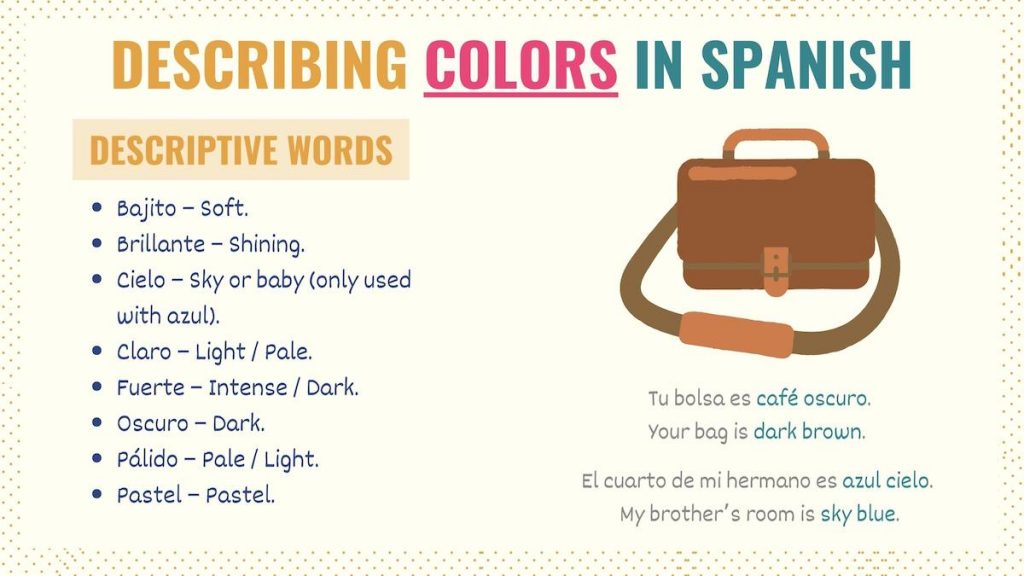 Gray And Brown In Spanish
Castaño, Moreno, and the Hair Problem
When brown describes hair or eyes, Spanish often switches words. Castaño means chestnut brown, and it’s common for hair: pelo castaño, ojos castaños. It sounds specific and natural, not like a paint label.
Moreno is trickier. It can mean dark-haired, brunette, tan, or dark-skinned, depending on the country and the person.
In Spain, moreno often means dark-haired. In parts of Latin America, it can describe skin tone in ways that carry social weight.
So if you call someone moreno, make sure you know the local vibe. You might be describing hair. You might be describing skin.
You might be accidentally commenting on race. Tread carefully, my friend.
Pardo, Canela, and Other Shades
Pardo is another brownish word, often dark, muted, or gray-brown. It shows up in oso pardo (brown bear) and in literary or formal descriptions. It’s not the first word you’ll need at a clothing store, but it’s good to recognize.
Canela means cinnamon, and it can describe a warm, reddish-brown. Chocolate works for deep brown, especially in food or fashion. These are more like flavor notes than basic color terms.
 PPT - Los colores PowerPoint Presentation, free download - ID:191283
Then there’s marrón again, quietly waiting in your vocabulary like a reliable friend. It may not always be the most local choice, but it rarely fails completely.
And don’t forget idioms. Azúcar moreno is brown sugar, while arroz integral is brown rice, though neither uses a color word in the way English does. Spanish loves to make you rethink what “brown” even means.
So, What Should You Actually Say?
Regional Cheat Sheet
If you’re in Spain, start with marrón. If you’re in Mexico or Colombia, try café for objects and castaño for hair. If you’re talking about a person’s skin, slow down and listen to how locals describe it before you join in.
And if you’re ever stuck, point. Pointing is universal, underrated, and much safer than accidentally asking for a brown coffee in a paint store.
Spanish has dozens of ways to say brown because brown itself refuses to be one thing. It’s coffee, chestnuts, bears, cinnamon, and wet cardboard.
Your job isn’t to memorize one perfect word. It’s to notice which brown you mean.
So go ahead: order the café, buy the marrón shoes, and describe your castaño hair.
