What Size Drill For 5 8 11 Tap

Saturday afternoon, the garage smells like cutting oil and ambition. You've got a 5/8-11 tap in one hand, a drill bit index in the other, and a project that suddenly feels ver...

Saturday afternoon, the garage smells like cutting oil and ambition. You've got a 5/8-11 tap in one hand, a drill bit index in the other, and a project that suddenly feels very specific. The question isn't philosophical: what size drill do you need?
The short answer is 17/32 inch, or about 13.5 millimeters. That's the standard tap drill for a 5/8-11 UNC thread at roughly 75% thread engagement. Write it on a sticky note, tape it to the drill press, and breathe.
The Math Behind the Magic
A 5/8-11 tap cuts a thread with a 5/8-inch major diameter and 11 threads per inch. The old shop formula says tap drill equals major diameter minus one divided by the thread pitch. So 0.625 minus 0.0909 gives you 0.5341 inches.
Must Read
The nearest common drill bit is 17/32, which measures 0.53125 inches. That's a hair smaller, which gives you slightly more thread engagement than 75%. In practice, it's the gold standard for this tap.
If you grab a 1/2-inch bit, the hole is too tight. You'll fight the tap, risk breaking it, and probably curse your ancestors. If you grab a 9/16-inch bit, the threads will be shallow and weak. Goldilocks would choose 17/32 every time.
Fun fact: 75% thread engagement is the shop standard because 100% is nearly impossible and snaps taps. Even 50% engagement holds a surprising amount of load. Threads are stronger than they look.
Metric Cousins and Clearance Confusion
If your drill index is metric, a 13.5 mm bit is your best friend. It measures 0.5315 inches, just 0.00025 inches larger than 17/32. For most home-shop projects, that difference is invisible to the naked eye and irrelevant to the tap.
But don't confuse a tap drill with a clearance drill. A tap drill cuts threads. A clearance drill lets a bolt slide through without grabbing. For a 5/8 bolt, you'd typically use 11/16 or 3/4 inch for clearance.
This matters because someone always says, "Just use the same size as the bolt." That advice is how stripped holes and wobbly brackets are born. Different jobs, different bits.
Angle Grinders and Other Thread Lore
Here's a fun fact: many angle grinders use a 5/8-11 spindle thread. That's why wire wheels, flap discs, and diamond blades spin on with a familiar growl. If you've ever changed a grinder accessory, you've already met this thread.
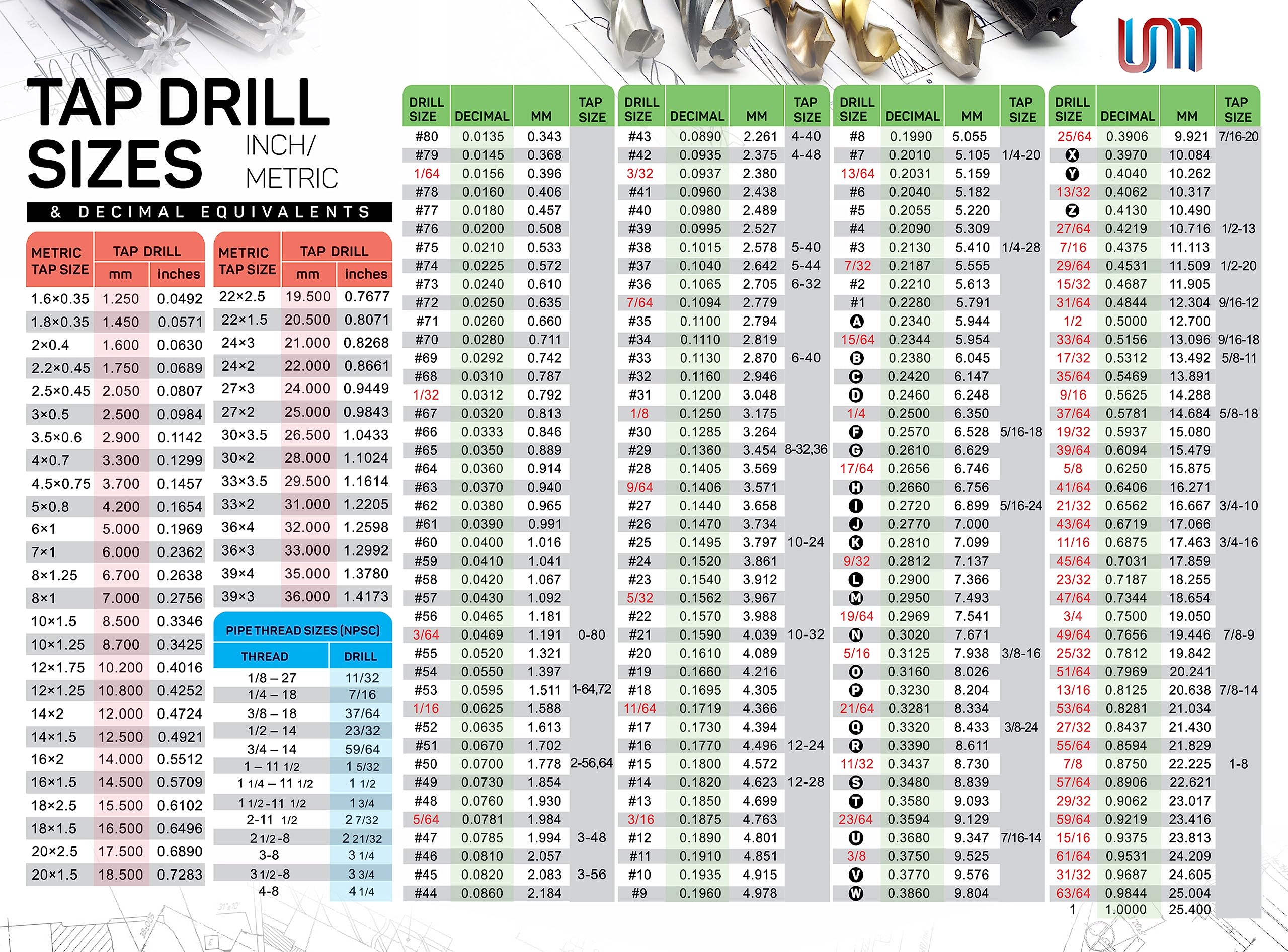 Tap Drill Chart Fractional at Robert Guajardo blog
The 5/8-11 size also shows up in threaded inserts, shop fixtures, and custom tooling. It's the rugged, blue-collar cousin of finer threads like 5/8-18. Coarse threads start easier and handle soft materials; fine threads resist vibration but need more care.
Thread standards are a quiet language. The Unified National Coarse system became common during World War II, when factories needed interchangeable parts. Before that, every shop had its own idea of a bolt. Imagine assembling IKEA furniture with randomly sized screws. Exactly.
Practical Tips from the Garage Floor
Clamp your workpiece. If it spins while you're tapping, you'll regret every life choice that led to that moment. A drill press vise or a pair of clamps is cheap insurance.
Start square. Use a center punch, then a pilot hole if you're hand-drilling. A tap guide or the chuck of a drill press can keep the tap aligned. Crooked taps cut crooked threads, and crooked threads make sad bolts.
Use cutting fluid. For steel, tapping oil or even motor oil works. For aluminum, a little kerosene or WD-40 helps. Brass and cast iron often cut fine dry, but a drop of oil never hurts.
Go slow. Turn the tap one full turn forward, then half a turn back to break the chips. This back-and-forth rhythm is the threading equivalent of dental floss: tedious, but it prevents disaster.
If the tap squeaks, stop. Squeak means friction, and friction means a snapped tap. Broken taps are the villains of every machinist's nightmare. Removing one is like playing Operation with a tungsten carbide prize.
 Tap drill chart – Artofit
A spiral-flute tap can pull chips out of blind holes, but it's not a magic wand. If you're tapping stainless steel, use a slower speed and a dedicated lubricant. Stainless work-hardens, so don't let the tap spin in place.
Taper, Plug, Bottoming
Most taps come in three flavors: taper, plug, and bottoming. A taper tap starts easily and cuts gradually. A plug tap is the general-purpose choice. A bottoming tap cuts threads almost to the bottom of a blind hole.
For a through hole, a taper or plug tap works fine. For a blind hole, start with a plug tap, then finish with a bottoming tap if you need threads near the bottom. The drill size stays 17/32 regardless.
Speed matters too. In steel, run your drill slow and steady. In aluminum, you can speed up a bit. Let the bit cut instead of rubbing, and don't lean on it like you're starting a stubborn lawnmower.
A Small Reflection on Big Connections
Maybe you're tapping a hole for a grinder fixture, a shop jig, or a custom lamp. The answer is 17/32, but the real lesson is preparation. Measure twice, align carefully, lubricate, and go slow.
Threads hold things together, but they also remind us that connection depends on precision and care. A hole that's too small strips the threads. A hole that's too large leaves everything loose. The right size lets two parts hold without drama.
So grab that 17/32 bit, sip your coffee, and let the tap do its quiet work. You'll end up with strong threads, a solid project, and a small, satisfying victory over friction.
