How Many Rail Cars In A Mile

Last summer, I stood on a rusty pedestrian bridge while a freight train rolled underneath. I decided to count the cars, because apparently I hate fun. By car forty-seven, a do...

Last summer, I stood on a rusty pedestrian bridge while a freight train rolled underneath. I decided to count the cars, because apparently I hate fun. By car forty-seven, a dog barked, I looked away, and the train kept coming.
That tiny failure led to a bigger question: how many rail cars actually fit in a mile? It sounds like a simple bar bet. It is not.
The answer depends on what you mean by rail car, how long it is, and whether you’re counting locomotives. Also, couplers exist, which is the universe’s way of making math annoying.
Must Read
The Quick, Unsatisfying Answer
For typical freight cars, a mile holds roughly 80 to 100 cars. That’s the number most people want when they ask. But it’s a range, not a rule.
Passenger cars are longer, so expect closer to 60 to 65 cars per mile. Autoracks? They’re enormous, so maybe 60 to 70, depending on the model.
If you include locomotives, the count drops a bit. Those things are powerful, but they hog the tape measure.
Of course, not every train is a neat string of identical cars. Mixed freight is the norm, and that’s where the headache begins.
Where the Math Comes From
A mile is 5,280 feet. That part is blessedly fixed. A rail car is not.
Take a common freight car around 60 feet long. Add about 2 feet for couplers and breathing room. Now you’re at 62 feet per car.
Divide 5,280 by 62 and you get about 85 cars. That’s your baseline. If the cars are 50 feet, the number climbs toward 100. If they’re 70 feet, it falls closer to 73.
But Wait—What Kind of Rail Car?
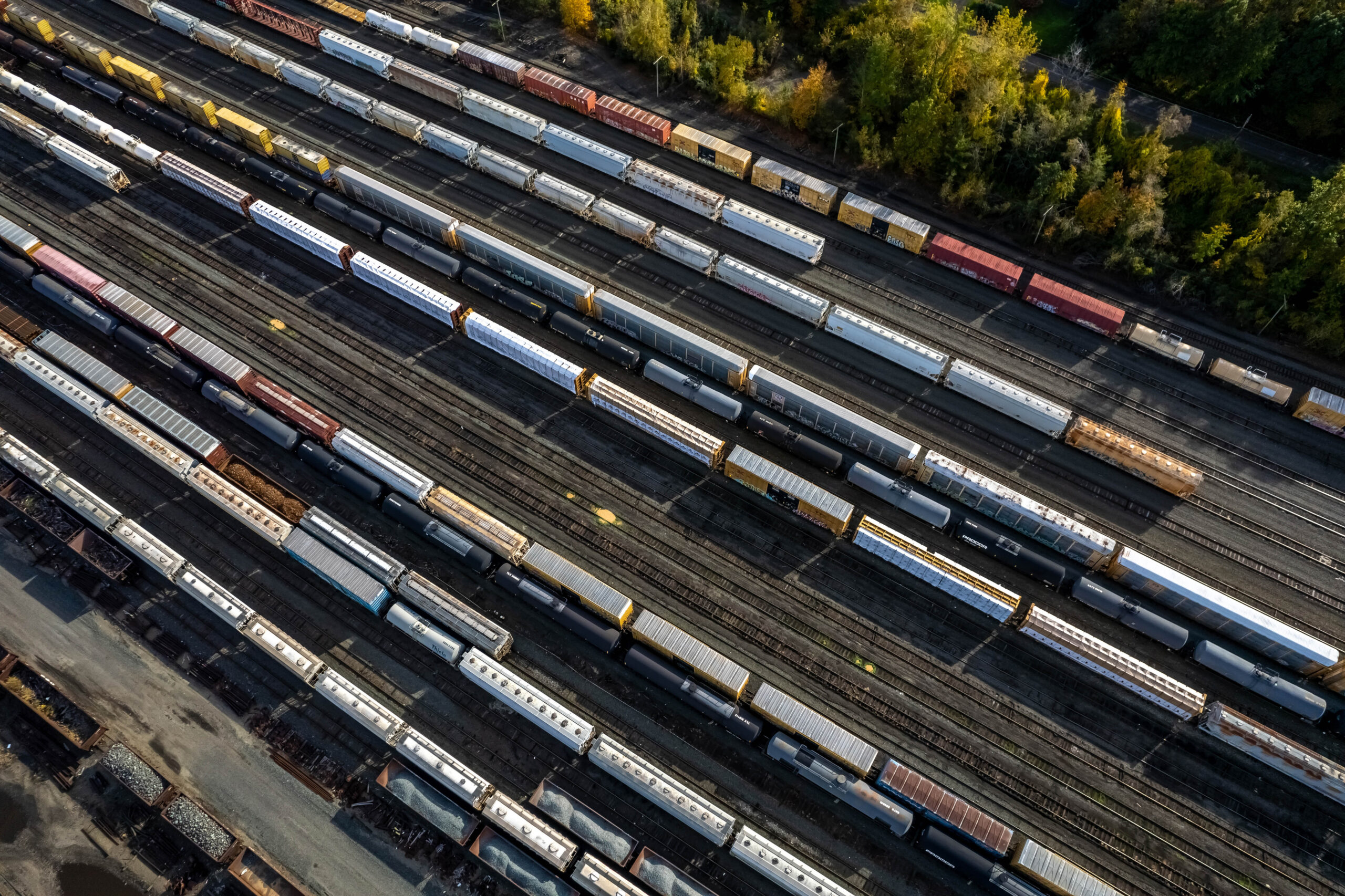
Boxcars often run 50 to 60 feet. Hoppers and gondolas are in a similar neighborhood. Tank cars can be shorter or longer, because standardization is for cowards.
 Streamline Rail Logistics with Yard Management
Autoracks are the long noodles of the rail world, often 80 to 90 feet. Intermodal well cars can be even longer when you count the containers hanging over the edge. So yes, your answer changes with the menu.
You might also see specialty cars for heavy equipment or molten metal. Those can be shorter, taller, or just plain weird. Railroading is a surprisingly creative industry.
This is why two rail fans can argue for an hour and both be correct. It’s not stubbornness. It’s context.
Couplers, Gaps, and Other Tiny Tyrants
You can’t just divide by the car’s body length. Each car needs space to connect to the next. Those couple inches and feet add up fast.
Couplers are the handshake between cars. Without them, you’d just have a very expensive parking lot.
Multiply a 2-foot gap by 90 cars and you’ve lost almost two car lengths. Suddenly your neat math has a spare tire.
Then there’s track curvature, grade, and how the train is assembled. A train on a curve eats up more linear distance than one on a straight arrow. Railroads measure train length carefully for exactly this reason.
Real railroads use train length and tonnage to plan everything from braking to yard space. A mile isn’t just a mile when you’re moving thousands of tons.
 How Many Cars Does The Longest Train Have at Jonathan Hoffman blog
What About a Mile-Long Train?
When someone says a train is “a mile long,” they usually mean it stretches about a mile along the track. That’s different from cramming individual cars into a mile of ruler.
A mile-long freight train might have 80 to 100 cars if it’s a mix of standard equipment. If it’s all autoracks, maybe 60 to 70. Add a few locomotives, and the car count shrinks again.
The Weird Joy of Counting
Next time you’re stuck at a crossing, try counting. You might lose track, get honked at, or develop a new respect for train length.
But you’ll start to notice the rhythm: car, gap, car, gap. It’s a moving math problem made of steel. And if you count 90 cars and the train is still rolling, congratulations—you’re probably watching more than a mile.
Also, don’t feel bad if you lose count. Professional railroaders don’t count cars one by one at crossings either. They use paperwork, sensors, and maybe a little black magic.
So, How Many Rail Cars in a Mile?
For a rough, blog-friendly answer: about 80 to 100 freight cars. For passenger trains, about 60 to 65. For autoracks, closer to 60 to 70.
If you’re measuring a specific train, look up its car types and lengths. Then do the division. Yes, this is homework now.
But the honest answer is it depends. Car length, couplers, locomotives, and train composition all mess with the math. That’s not a flaw. That’s the whole point.
And if you ever find yourself counting rail cars from a bridge, remember: the train doesn’t care about your arithmetic. It just keeps rolling.
